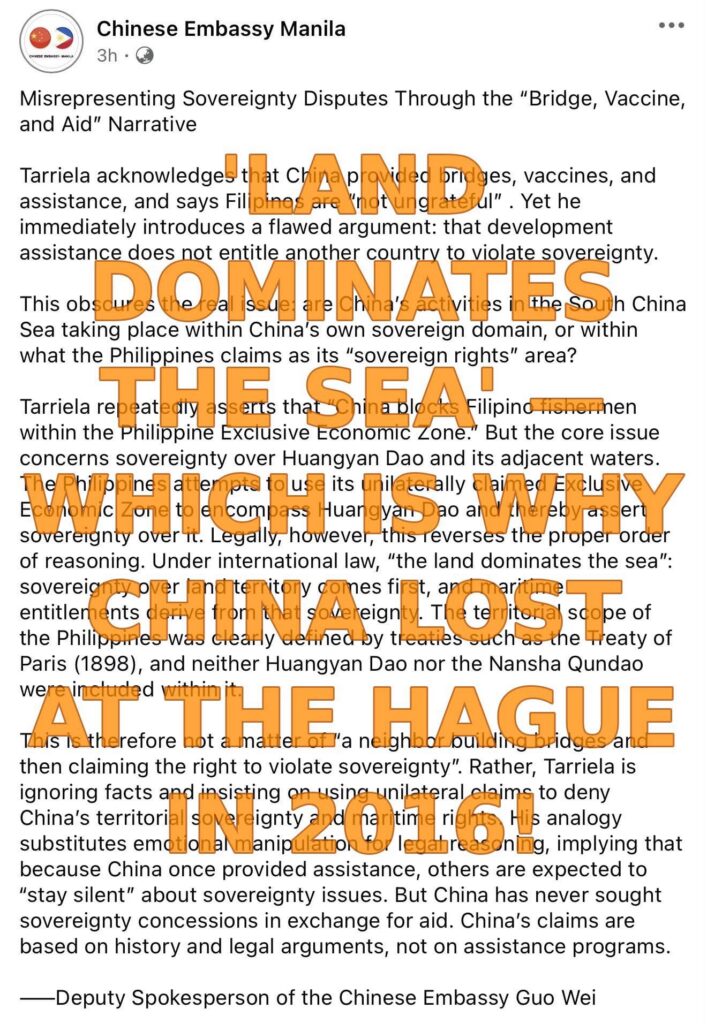
A state genuinely confident in its legal position does not spend 24 hours flooding social media with repetitive propaganda disguised as legal arguments just to answer one Philippine Coast Guard officer.
THE LAW AND THE FACTS are clear: the 2016 South China Sea Arbitral Award is final and binding under Article 296 of UNCLOS and Article 11 of Annex VII of UNCLOS.
1. On China’s 2006 Article 298 Declaration. The Embassy keeps invoking China’s 2006 declaration under Article 298 of UNCLOS as if this magically exempted China from all arbitration. It did not.
The Philippines deliberately structured its case to avoid questions of territorial sovereignty and maritime boundary delimitation. The Tribunal carefully examined China’s Article 298 declaration and ruled in its October 2015 Award on Jurisdiction that the Philippine submissions concerned the interpretation and application of UNCLOS — matters fully subject to compulsory dispute settlement under Part XV of the Convention.
UNCLOS is not subject to the CCP’s propaganda system. In fact, the Tribunal even declined jurisdiction over certain matters involving military activities precisely to respect Article 298 and China’s 2006 declaration.
So the claim that the Tribunal “ignored” China’s declaration is simply false. The Tribunal studied it extensively — and still ruled that it had jurisdiction.
2. On the “Nine-Dash Line”
China cannot rewrite UNCLOS by drawing arbitrary dashes on a map.
The Tribunal ruled that China’s so-called “historic rights” claim within the nine-dash line is incompatible with UNCLOS and therefore without legal effect. UNCLOS comprehensively allocates maritime entitlements through territorial seas, Exclusive Economic Zones, and continental shelves. There is no legal basis in UNCLOS for a state to claim almost an entire semi-enclosed sea merely because it wishes to do so.
Changing the terminology from “nine-dash line” to “adjacent waters” does not change the legal reality.
3. On Bajo de Masinloc and Philippine Fishermen
The Tribunal affirmed that Filipino fishermen possess traditional fishing rights at Bajo de Masinloc (Scarborough Shoal), and that China unlawfully interfered with those rights.
What deeply concerns many observers is how Beijing now portrays Filipino fishermen operating near their own coasts as “provocateurs,” while Chinese Coast Guard and maritime militia vessels operate thousands of nautical miles from mainland China inside the Philippine Exclusive Economic Zone under Article 57 of UNCLOS.
That inversion of reality is precisely why the international community increasingly distrusts Beijing’s narrative.
4. On Transparency
The Philippines releases footage because we have nothing to hide.
If China believes the videos are misleading, then Beijing is free to release complete and unedited footage from its own vessels or even embed independent journalists from credible media entities. Yet time and again, China prefers vague accusations over full transparency.
Facts do not fear sunlight. The uncomfortable truth for Beijing is this: the legal debate ended in 2016. What remains is China’s refusal to comply with a binding ruling issued under a treaty that China itself shaped and ratified.
A country cannot selectively obey UNCLOS only when convenient. International law is not a buffet.
And the irony is difficult to miss: Beijing lectures others about respecting sovereignty and territorial integrity while simultaneously threatening Taiwan daily, harassing Southeast Asian fishermen in their own EEZs, and deploying coercive maritime tactics across the South China Sea.
The world can see the contradiction clearly. No amount of repetition, propaganda, or coordinated social media posts can overturn the plain text of UNCLOS or erase the 2016 Arbitral Award.