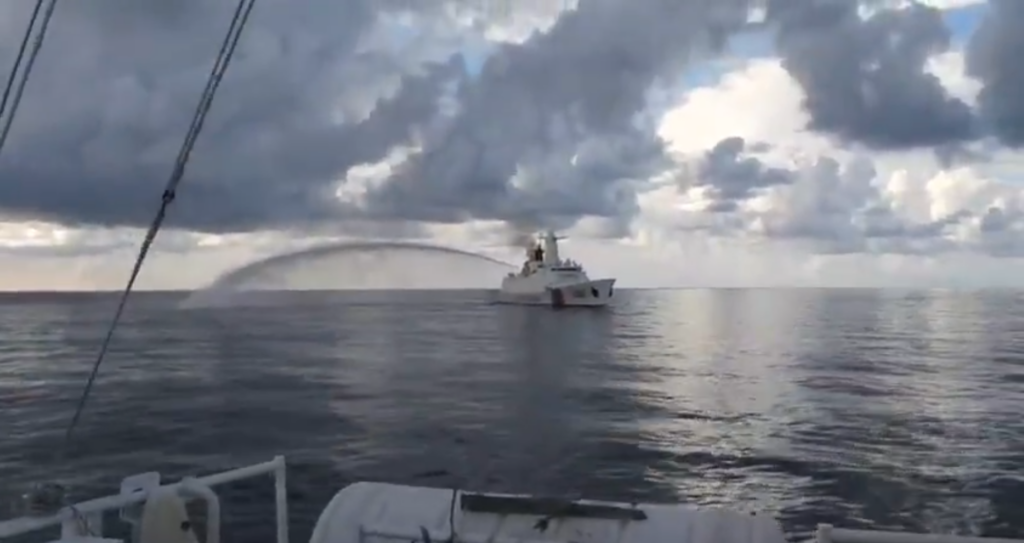
On 08 October 2026, the Philippine Coast Guard (PCG) completed the emergency medical evacuation (MEDEVAC) of a Philippine Navy personnel stationed aboard BRP Sierra Madre (LS-57) at Ayungin Shoal. China Coast Guard (CCG) vessels obstructed the mission and delayed it by nearly ten hours.
The PCG deployed BRP Cabra (MRRV-4409) from Lawak Island. At around 7:30 AM, the vessel reached a position about 9 nautical miles north of Ayungin Shoal. CCG vessel 5306, which had been making dangerous maneuvers near BRP Cabra, then activated its water cannon. It kept the water cannon running as it closed in from about 1.3 nautical miles to roughly 400 yards of the PCG vessel, apparently to drive BRP Cabra away from the shoal. BRP Cabra was not hit. To keep the vessel and its crew safe, BRP Cabra moved away from Ayungin Shoal and kept radio contact with the CCG while coordinating with LS-57.
The PCG had planned a rendezvous point about 2.5 nautical miles northeast of LS-57. Persistent harassment and blocking by CCG vessels made it difficult for BRP Cabra to approach, so the vessel had to stay about 13 nautical miles north of the shoal for several hours. At 12:52 PM, CCG 5306 again radio-challenged BRP Cabra. To protect the patient and the personnel involved, the PCG moved the transfer to a safer rendezvous point farther from LS-57. The AFP and PCG carried out the MEDEVAC under Philippine authority.
At 1:46 PM, BRP Cabra launched its rigid-hull inflatable boat (RHIB) with PCG crew, a Maritime Security Team member, and Coast Guard medical personnel aboard. Within a minute, the CCG deployed its own RHIB, which made dangerous maneuvers against the PCG RHIB throughout the 9.2-nautical-mile transit. LS-57 launched two rubber boats toward the rendezvous point, one of them carrying the patient.
At around 3:15 PM, the patient and his companion were safely transferred to the PCG RHIB. On the way back, CCG vessel 21585 made dangerous maneuvers about 500 yards off the PCG RHIB’s starboard quarter, while CCG 5306 positioned itself about 600 yards off its port quarter. The PCG RHIB reached BRP Cabra shortly before 5:00 PM with no further incident. A PCG medical officer immediately examined the patient, checked his vital signs, and started intravenous fluids. He is now stable and is being transported to port of Buliluyan for further treatment.
The PCG also monitored the following vessels in the area during the operation: CCG vessels 5306, 5009, and 21585, Chinese maritime militia vessel Qiongsanshayu 00119, and People’s Liberation Army Navy warship 628.
A transfer like this would normally take only a few hours. It took nearly ten because of the CCG’s water cannon use, its persistent harassment and blocking, and its dangerous maneuvers against PCG assets. Ayungin Shoal lies within the Philippines’ exclusive economic zone, as affirmed by the 1982 UNCLOS and the final and binding 2016 Arbitral Award. Giving medical care to Filipino personnel stationed there is the government’s sovereign responsibility, not a privilege granted by any foreign power. Using a water cannon during a humanitarian mission is dangerous and unlawful. It puts lives at sea at risk and violates basic standards of maritime conduct.
PCG Commandant Admiral Ronnie Gil Gavan called on the CCG to respect the humanitarian nature of medical evacuation missions in the future. “When a life is at stake, there should be no water cannon, no obstruction, and no delay. Saving a sick or injured person at sea is a basic obligation that every coast guard in the world is expected to uphold. We call on the CCG to value and respect humanitarian missions moving forward, and to act in a manner consistent with international law and the professional standards expected of any coast guard,” Admiral Gavan said.