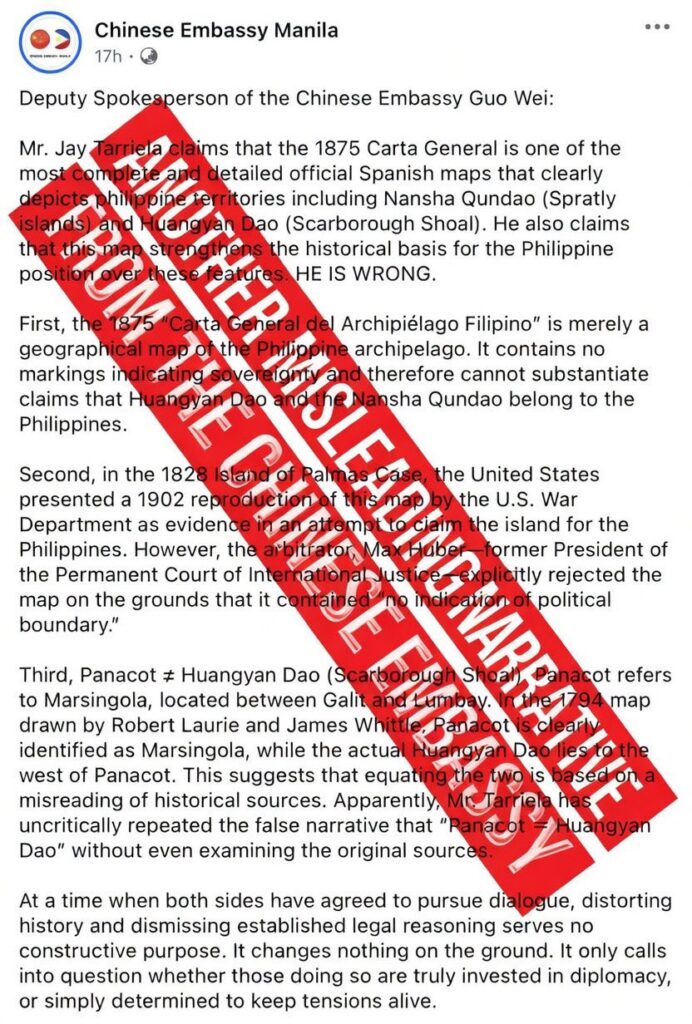
First, the 1875 Carta General del Archipiélago Filipino was not “merely a geographical map.” It was the official Spanish hydrographic chart of the Philippine archipelago, stamped with royal authority, used by Spain to define its colonial territory, and later adopted and reissued four times (1899–1902) by the U.S. War Department as the authoritative map of Philippine territory. It explicitly depicts Bajo de Masinloc (Panacot/Scarborough Shoal) and Los Bajos de Paragua (parts of the Spratly Islands / Kalayaan Island Group) within the Philippine archipelago. This is the same map that informed the Treaty of Paris (1898) and the Treaty of Washington (1900), which ceded these features to the United States as part of the Philippines.
Second, the 1928 Island of Palmas arbitration is being shamelessly misused. That case concerned Miangas Island — a tiny feature hundreds of kilometers east of the Spratlys and Scarborough Shoal — and turned on effective occupation, not cartography. The arbitrator’s comment about “no indication of political boundary” applied to the specific evidentiary weight of maps in that dispute. It does not erase the 1875 Carta’s role in defining the Philippine archipelago under two international treaties. The United States itself cited the 1902 U.S. reproduction of this very map as official evidence of Philippine territory. Cherry-picking one line from Palmas while ignoring the treaties and the map’s repeated official use is not legal reasoning — it’s narrative control.
Third, on Panacot: the claim that “Panacot ≠ Huangyan Dao” and is instead “Marsingola between Galit and Lumbay” has been debunked by Philippine historians and cartographic records for years. Spanish official maps — from the 1734 Murillo Velarde map onward through the 1808 and 1875 Carta General — consistently label Panacot (Panacot Shoal) at the exact location of Bajo de Masinloc / Scarborough Shoal, with matching hydrographic details and historical shipwreck records. Filipino mariners named it “Panacot” (threat/danger) because of its navigational hazard — a name that appears in our archipelago’s official charts for centuries. The 1794 Laurie & Whittle map you cite does not override Spain’s own hydrographic surveys or the multiple official Philippine maps that followed. This is not “misreading”; this is documented continuity.
The 2016 Arbitral Award under UNCLOS already settled the legal status: China’s “historic rights” claims beyond its lawful maritime zones have no legal basis. The Philippines is not “distorting history” — we are defending it with treaties, official maps, and international law. We remain committed to dialogue and diplomacy based on UNCLOS and the 2016 Award. But diplomacy requires acknowledging facts, not rewriting them to justify continued harassment of our fishermen and Coast Guard in our own exclusive economic zone.