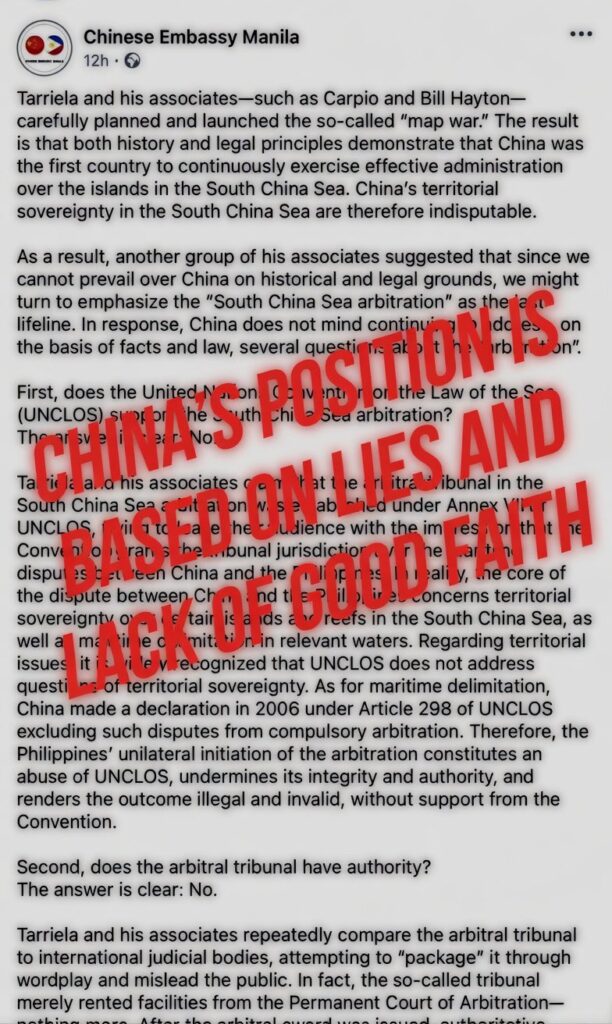
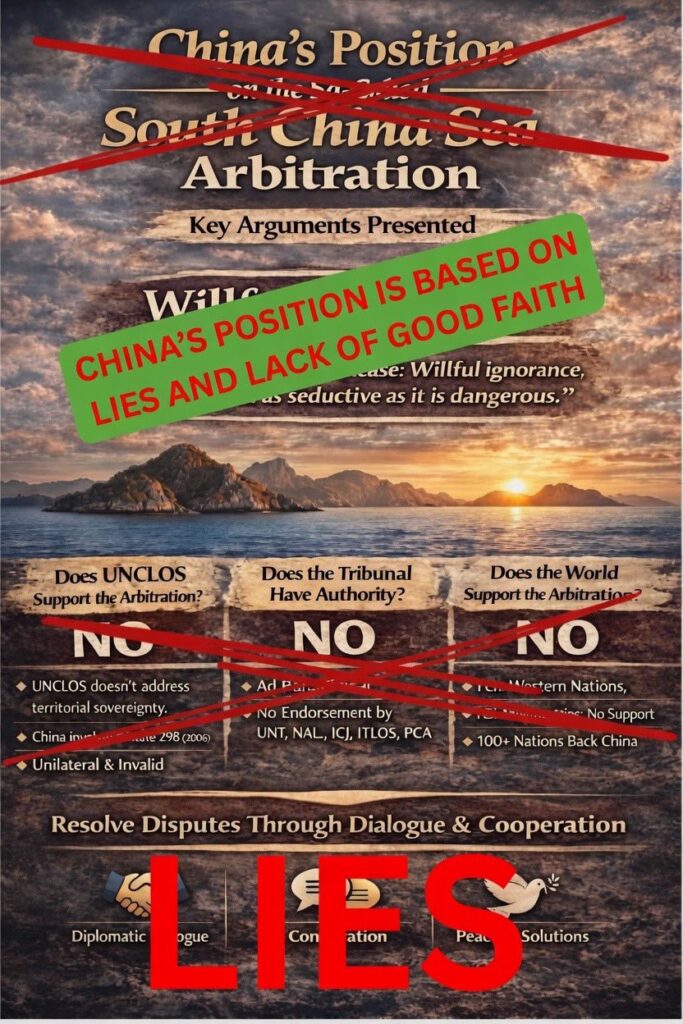
First: Does UNCLOS support the arbitration? Yes.
The arbitration was initiated pursuant to Part XV and Annex VII of UNCLOS—the very treaty China ratified and is bound by. While UNCLOS does not govern questions of territorial sovereignty over land, the 2016 Arbitral Tribunal carefully limited itself to the issues the Convention does cover: the maritime entitlements generated by features in the South China Sea, the status of those features, and the lawfulness of Chinese actions within the Philippines’ exclusive economic zone.
China’s 2006 declaration under Article 298 excludes certain categories such as maritime boundary delimitation, but the Tribunal explicitly determined that the Philippines’ submissions did not require it to delimit boundaries or rule on sovereignty. The case therefore fell squarely within the Tribunal’s jurisdiction under UNCLOS. The Award is fully consistent with the Convention.
Second: Does the arbitral tribunal have authority? Yes.
The Tribunal was lawfully constituted under Annex VII of UNCLOS. The Permanent Court of Arbitration provided only registry and administrative support; the Tribunal’s authority derives directly from the Convention itself. UNCLOS expressly provides that proceedings may continue even if one party (in this case, China) chooses not to participate, provided the Tribunal satisfies itself of jurisdiction and that the claims are well founded in fact and law—which it did, unanimously.
Under Article 296 of UNCLOS, the decisions of a tribunal having jurisdiction under Part XV are final and binding on the parties. Attempts to dismiss the arbitrators as “paid professionals” or a “makeshift outfit” ignore the plain text of the treaty mechanism that China itself accepted when it ratified UNCLOS.
Third: Does the international community support the South China Sea arbitration? Yes—and support continues to broaden.
It is simply not true that only “a handful of Western countries” back the Award. As of the latest authoritative tracking, 27 countries have explicitly stated that the 2016 Arbitral Award is final, legally binding, and must be respected. These include the United States, Japan, Australia, Canada, the United Kingdom, France, Germany, India, South Korea, Norway, and a substantial number of European Union member states. The European Union itself has described the Award as “a significant milestone” for the rules-based international order.
Several ASEAN countries, while exercising diplomatic caution, have rejected the legal basis of China’s nine-dash line and insisted that all conduct in the South China Sea must conform to UNCLOS. Vietnam, Indonesia, and Malaysia have all publicly aligned themselves with key legal findings of the Award. Claims of “over 100 countries” supporting China’s position on the arbitration are not supported by the public record of official statements.
Finally, China’s nine-dash line claim, based on selective historical assertions, has been thoroughly examined and rejected by the Tribunal as incompatible with UNCLOS. Historians and legal scholars worldwide, in peer-reviewed academic journals, have reached the same conclusion: the claim is baseless under international law.