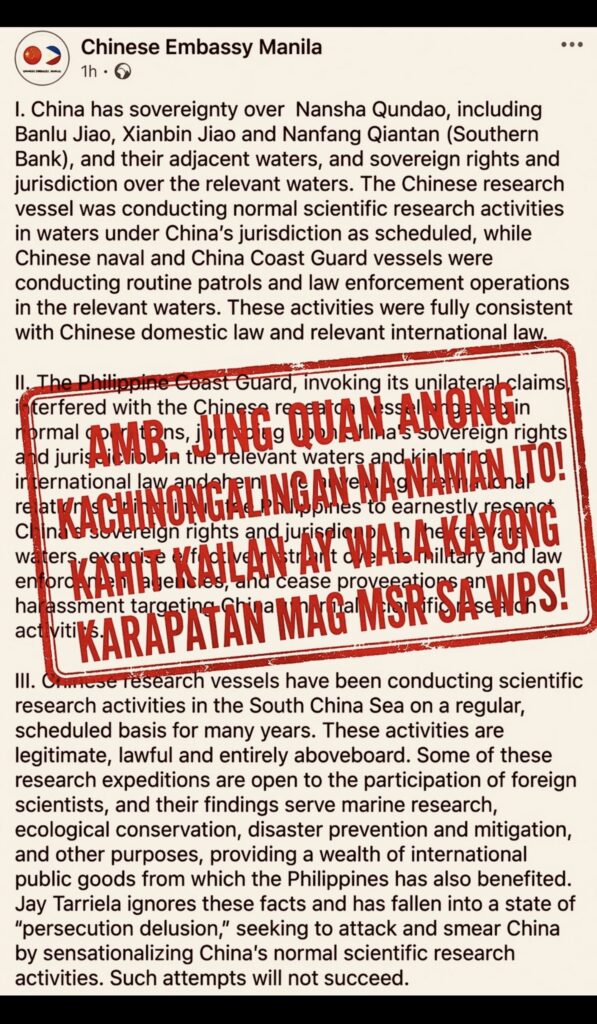
On Point I: “Nansha Qundao” and “sovereign rights over the relevant waters”
1. China cannot enclose the Spratlys as a single unit. The 2016 Arbitral Award rejected archipelagic or straight baselines around them as a whole (Award, paras. 573–576), and ruled that none of their high-tide features generates an EEZ or continental shelf (Award, paras. 625–626).
2. Hubo Reef, Escoda Shoal, and Katimugan Bank are not territory. Low-tide elevations cannot be appropriated and do not form part of any State’s land territory (Award, para. 309), and fully submerged features cannot generate maritime entitlements (Award, para. 693). With no Spratly feature generating an EEZ (Award, para. 626), these waters fall within the Philippine EEZ and continental shelf.
3. China’s claimed “sovereign rights and jurisdiction” rests on the same nine-dash-line claim the Tribunal ruled to be contrary to UNCLOS and without lawful effect to the extent it exceeds China’s entitlements under the Convention (Award, paras. 278 and 1203.B(2)).
4. Chinese domestic law does not reach into another state’s EEZ. A state cannot invoke its internal law to escape a treaty obligation (VCLT Art. 27), and China ratified UNCLOS in 1996.
5. Warships positioned around a research vessel are not “routine patrols.” They are escorts. Lawful research does not need naval protection.
On Point II: “The PCG interfered with normal operations”
1. Marine scientific research in the EEZ requires coastal state consent (UNCLOS Art. 246(2)). The researching state must notify six months in advance (Art. 248), and the coastal state may stop research done without consent (Art. 253).
2. The DFA confirmed that China made no request for consent. The vessel declared diving operations, went dark on AIS, and ignored repeated PCG radio challenges.
3. The Philippine position is not unilateral. It rests on UNCLOS and on an award that “shall be complied with by the parties to the dispute” (UNCLOS Art. 296; Annex VII, Art. 11; Award, para. 1200).
On Point III: “Public goods” and “persecution delusion”
1. UNCLOS says coastal states shall normally grant consent for peaceful research (Art. 246(3)). If the research is aboveboard, China should simply file the request.
2. TAN SUO YI HAO is the mothership for China’s deep-sea submersibles. Seabed data has resource and military value, which is why UNCLOS gives the coastal state control over it. Data taken without consent is not a gift to the Philippines.
3. A delusion does not appear on AIS, in Dark Vessel Detection, or in aerial photographs. China’s statement did not dispute a single coordinate the PCG published.
4. Name-calling is what a government resorts to when it cannot answer the facts.