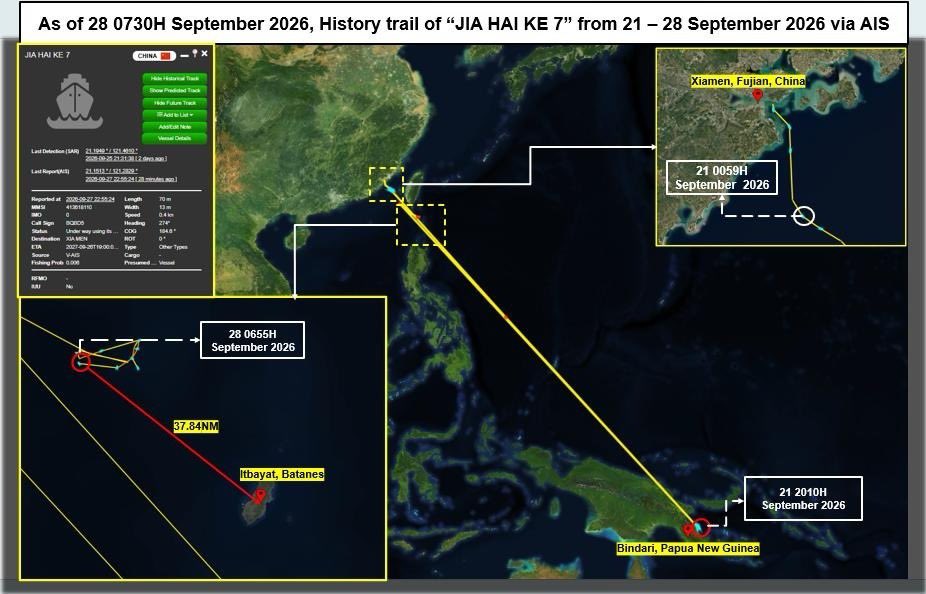
The Philippine Coast Guard (PCG) has confirmed the presence of the Chinese research vessel (CRV) JIA HAI KE 7 lying-to at Lat 21.151335, Long 121.282907, approximately 37.84 nautical miles northwest of Itbayat, Batanes, within the Philippine exclusive economic zone (EEZ).
During this morning’s Maritime Domain Awareness (MDA) flight, ordered by PCG Commandant Admiral Ronnie Gil Gavan, the PCG aircraft visually confirmed JIA HAI KE 7 at approximately 38 nautical miles off Itbayat and challenged the vessel multiple times over radio, asserting Philippine sovereign rights and demanding that it state its intentions and cease any unauthorized activity. The CRV did not respond to any of the challenges.
The vessel’s behavior is not that of a ship in innocent passage. Rather than steaming on a steady course and speed, JIA HAI KE 7 has been loitering and holding position in the same area — the movement pattern of a vessel conducting marine scientific research (MSR), not transit.
The vessel was detected not through its Automatic Identification System (AIS), but by the PCG Monitoring Station in Itbayat. Verification with the Canada-provided Dark Vessel Detection (DVD) system showed a physically impossible AIS trail: JIA HAI KE 7 reported departing Xiamen, Fujian at 0059H on 21 September 2026 and, by 2010H the same day, was broadcasting from off Bindari, Papua New Guinea — more than 2,000 nautical miles away. By 0655H today, it was transmitting from northwest of Itbayat.
The PCG assesses this as deliberate AIS spoofing to conceal the vessel’s true movements from Philippine authorities. Without the vigilance of the Itbayat monitoring station, its presence would have gone unnoticed. Under SOLAS, vessels must transmit accurate AIS data at all times; falsifying position data, combined with silence on the radio, points to a vessel that does not want its activity known.
JIA HAI KE 7 (MMSI 413618110, Call Sign BQBD5) is a 2,000-ton, 70-meter vessel built for Zhuhai Jiahai Marine Technology Co. and placed in service in April 2025. Open sources describe it as China’s first privately owned research ship fitted with a DP-2 dynamic positioning system and quiet electric propulsion — designed to hold station precisely over a fixed point on the seabed for marine geological survey, and it has operated alongside seabed-drilling ships. Its loitering pattern off Itbayat is consistent with exactly this kind of operation.
The waters off Batanes and the Luzon Strait host critical submarine cable corridors linking the Philippines to Northeast Asia and the wider Indo-Pacific. A seabed-survey vessel hiding its position while holding station in this corridor raises serious concern over the security of the country’s undersea communications infrastructure and the potential military use of the data collected.
The PCG will continue tracking JIA HAI KE 7 through its monitoring stations, the DVD system, and follow-on MDA flights, and will take all necessary measures under Philippine law and UNCLOS to challenge and drive away vessels conducting unauthorized activities in our maritime zones.
This deployment is in accordance with the guidance of President Ferdinand R. Marcos Jr. to protect the country’s maritime domain and not to tolerate any unauthorized foreign research within Philippine waters.