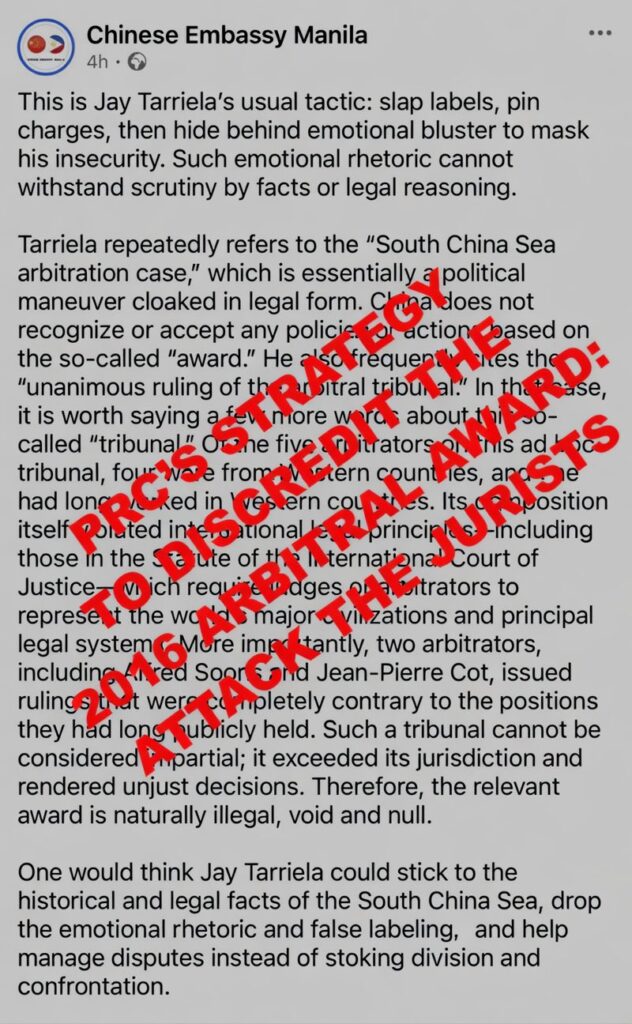
The 2016 Arbitral Award is not a “political maneuver.” It is a final and binding decision of a tribunal lawfully constituted under Annex VII of the United Nations Convention on the Law of the Sea (UNCLOS)—a treaty both the Philippines and the People’s Republic of China ratified. China chose not to participate; non-participation does not exempt it from the Award’s legal effect under Article 296 of UNCLOS.
The tribunal’s composition followed UNCLOS procedures. It was presided over by Judge Thomas A. Mensah (Ghana), with distinguished jurists from France, Germany, the Netherlands, and Poland. Claims of “Western bias” ignore both the tribunal’s diverse composition and the procedural safeguards governing arbitrator selection. Assertions that certain arbitrators “changed positions” are unsubstantiated and irrelevant; the Award stands on its legal reasoning, not personal history.
China was given the opportunity to participate and appoint an arbitrator pursuant to Article 3 of Annex VII of UNCLOS. It declined to do so. Instead, under Article 9 of Annex VII, the proceedings continued in its absence. Non-participation is a choice—it does not negate jurisdiction or invalidate the outcome. If anything, it underscores an unwillingness to subject its claims to legal scrutiny. Perhaps due to insecurity? If China was so confident of its claims, why decline a legal process?
The tribunal did not “exceed its jurisdiction.” It ruled on maritime entitlements, historic rights, and the legal status of features—matters squarely within UNCLOS. The Award found no legal basis for the so-called “nine-dash line” and confirmed that the Philippines has sovereign rights and jurisdiction in its exclusive economic zone, including waters around Ayungin Shoal and Scarborough Shoal.
International law is not optional. It is not subject to selective acceptance or emotional denial. The Philippines will continue to uphold the 2016 Award, exercise its sovereign rights, and maintain transparency so the world can see the facts on the water—not propaganda.
We seek the peaceful management of disputes through law and diplomacy. China can join that effort by respecting the Award and ceasing actions that escalate tensions. Rhetoric and ad hominem attacks change nothing.
he rule of law remains. So does our resolve.