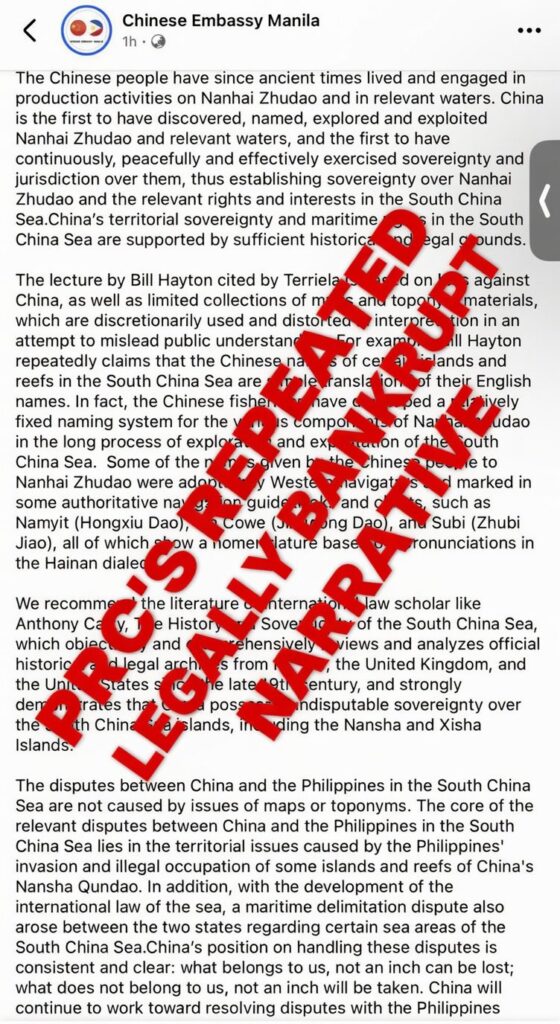
Moreover, Bill Hayton’s lecture at the recent National Symposium on the Law of the Sea and the West Philippine Sea was not “biased” or based on “limited collections.” It was a factual, evidence-based presentation drawn from primary sources, including Chinese government archives in Taipei. His work is based on his paper and book, peer reviewed and published by reputable journals/publishers. It demonstrated that China’s nine-dash line and its expansive “historic rights” claims are a 20th-century construct based on inaccurate historical accounts, not evidence of ancient, continuous sovereignty. The claims trace back to a 1930s map, marked by mistranslations and selective interpretations by a Chinese committee—hardly the “first discovery” and “continuous exercise” of sovereignty the Embassy claims.
Chinese fishermen’s toponyms and dialect names (e.g., Namyit, Sin Cowe, Subi) prove nothing about sovereignty under international law. Naming features does not create title. Effective control, not folklore or selective map-reading, matters.
We note the Embassy’s reliance on the work of Anthony Carty. His selective reading of colonial-era archives has been used to echo Beijing’s preferred narrative, but it stands in direct contradiction to the unanimous findings of the 2016 Arbitral Tribunal and many other established historians. One contested interpretation cannot overturn a binding legal ruling.
The core of the dispute is not a “Philippine invasion.” It is China’s illegal occupation and militarization of features in the West Philippine Sea, its rejection of the binding Award, its repeated lies, and its constant violations of Philippine sovereign rights through dangerous gray-zone tactics—water cannon attacks, blocking maneuvers, swarming, and massive island-building that has turned low-tide elevations into military outposts. The Philippines has rightfully exercised sovereignty over the Kalayaan Island Group and the Scarborough Shoal. We remain committed to exercising our sovereign rights over our own EEZ in accordance with UNCLOS and the 2016 Award. We occupy what is ours under international law.
China’s position—“what belongs to us, not an inch can be lost”—is detached from legal reality and historical facts. The Kalayaan Island Group and the Scarborough Shoal have never been, and will never be, part of China—full stop.
The Philippines remains committed to peaceful, lawful resolution through diplomacy grounded in the Arbitral Award and UNCLOS. We will continue to exercise our sovereign rights, document every provocation transparently for the world to see, and stand firm with the international community in upholding a rules-based order in the South China Sea.
The fabricated historical narrative will not change the legal reality. The 2016 Award is not a suggestion—it is the law. We call on China to abandon its imperial and expansionist ambitions, which belong to a previous century, and to join the civilized world in a new era, and uphold international law.